
Šibenik-Knin County
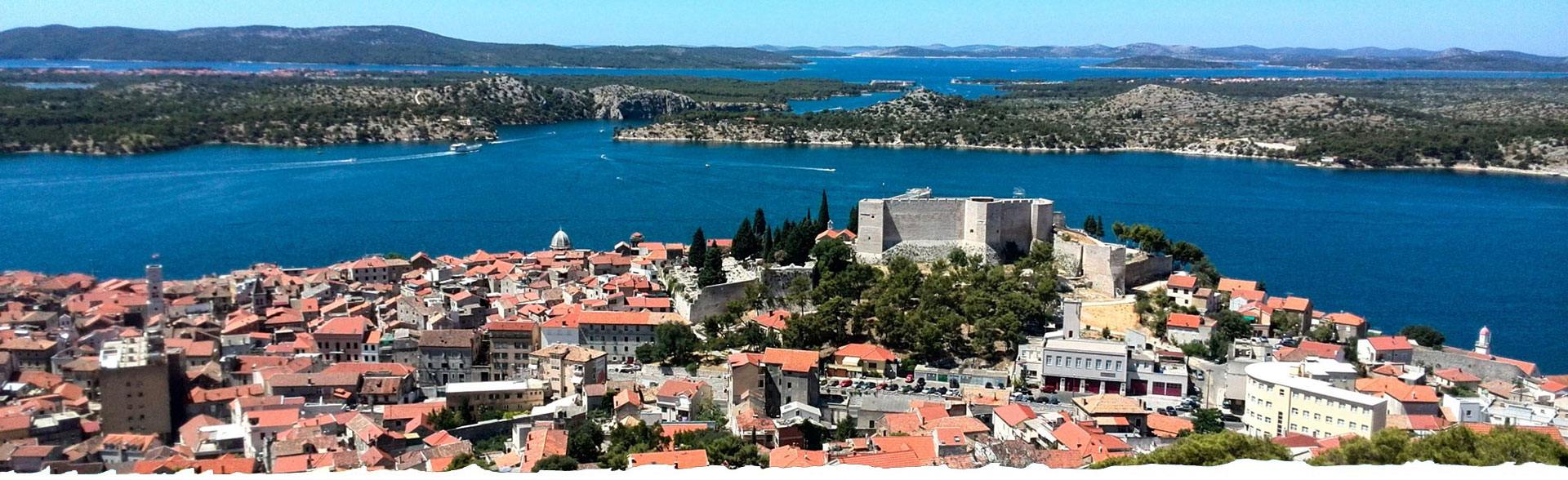
Šibenik is a city in northern Dalmatia, located at the mouth of the Krka River into the Adriatic Sea. It is the main city of Šibenik-Knin County and the oldest indigenous Croatian city on the Adriatic coast. It was first mentioned in 1066 in a charter by King Petar Krešimir IV, which is why it is often referred to as Krešimir’s City. The official city status it received in the 13th century is the main reason for the construction of its main symbol, the Cathedral of St. James, a famous building included on the UNESCO World Heritage list. The city of Šibenik is often called the City of Children because it has hosted the famous International Children’s Festival for nearly 60 years.
The Cathedral of St. James is the most significant architectural achievement of the 15th and 16th centuries in Croatia. In terms of its beauty, construction techniques, and stylistic features, it is not only the largest and most significant architectural heritage site in Šibenik but also a unique monument of European sacred architecture. In terms of its artistic value, it ranks among the most significant European monumental cathedrals.
Fort St. Nicholas, one of the newest additions to the UNESCO World Heritage List, was built during the 16th century as part of the Venetian defensive system established between the 15th and 17th centuries. It is located at the entrance to St. Anthony’s Channel. The construction of the fortress was an important undertaking, not only for the citizens of Šibenik but also for its rulers, as it was built to defend the city against Turkish attacks from the sea. The fortress, erected at the entrance to the narrow, 1500-meter-long channel, became an important strategic defensive structure that contributed to the invulnerability of the Šibenik port and the city of Šibenik itself. The only possible entrance to the Šibenik Bay was through the channel, which allowed for effective defense and complete control of ship entry.


Natural Beauties
Krka is one of the most beautiful, unusual, and enigmatic rivers in Europe. Its most beautiful adornments—the waterfalls—are not merely physical barriers in the water flow, but living entities that are born, grow, and die. It has 2 tributaries, 5 inflows, 7 waterfalls, and 11 lakes, making it the richest river in the Adriatic basin in terms of fish species and recognized as an ichthyological monument of the highest global category. Furthermore, Krka is a first-class natural monument in terms of the number and diversity of birds, placing it among the most valuable ornithological areas in Europe.
The Cetina Springs site, covering an area of 29.81 hectares, was protected in 1972. A series of karst springs, three of which are the main ones: Veliko vrilo, Vuković vrilo, and Batić vrilo, has formed along the edge of Paško Polje, at the foot of Dinara. All the springs formed at the contact of impermeable clay in the field and impermeable limestone of the surrounding plateau and are of the rising type. They attract attention with their distinct clarity and turquoise color. Veliko vrilo, or the Glavaš spring, is a submerged speleological object that divers have explored up to a depth of 150 meters. Near the springs is the oldest early Croatian church in Croatia—St. Spas Church. The church, built in the 9th century, features pre-Romanesque design with a bell tower. Next to the church is a cemetery with stećci, dating back to the 14th and 15th centuries.
The significant location of Makirina Hill is situated right at the entrance to Pirovac from the southern side. It is a micro-ecological and ornithological reserve, with natural spawning grounds at its northwestern and southwestern foot. Recognized as a prominent natural asset, this area has been included in Natura 2000. At an altitude of about 113 meters, there is the Makirina viewpoint, which offers a view of Pirovac, Pirovac Bay, and Vransko Lake.
At the foot of the hill, in the southern part of the expansive Pirovac Bay, lies the shallow Makirina Cove, historically known for its therapeutic mineral mud (peloid) and waters of exceptional quality, surpassing all known locations in Croatia. In close proximity is a valuable archaeological site—the Church of St. Martin, the cemetery, the remains of Roman buildings, and a Roman saltworks worth visiting.


